

Since this one runs a bit longer than what usually goes out here, here's a quick recap / TL;DR. Though the whole point of the piece is exactly what we lose by summarizing:
Feeds are more and more manipulated by commercial and political interests dressed up as public opinion. It's gotten so bad that people inside the industry already treat spontaneous virality as rare. That, plus how the platforms have evolved, kills the myths of social media as the voice of the people and as a meritocratic open mic.
Since the algorithm is the one calling the shots, anything that doesn't obey the aesthetic and the language it wants gets pushed out or made invisible, while denser sources sit behind paywalls or demand time. The result: brutal incentives for bullsh*t across every field of knowledge, and that amplified volume is the root of a credibility crisis. I'm calling it bullsh*tmaxxing.
A few examples of how this shows up in research and insights.
The uncomfortable hypothesis: there's no getting out of this through the same door we came in, if the feed controls the form and tone of everything that gets made. The way out, if there is one, is outside it.
A recurring theme when you listen to creators of every size and subject talk about their own creative process (especially the ones who make content about making content) is the worry about figuring out what the algorithm is rewarding. The topic, the aesthetic (YouTube thumbnails as maybe the best example), songs that are trending (on TikTok especially), hooks that might be a catchphrase or a quick camera move to make sure whatever got made survives those few critical seconds where the viewer decides whether to stick around, and so on.
If pleasing the machine matters that much and is the baseline condition for getting wide distribution, who are we actually serving? Precisely because winning over the algorithm is such a big part of the visibility of so many things, instances of manufacturing consensus through active manipulation of the algorithms while posing as public opinion are more and more frequent:
In one of the most interesting pieces I've read lately, "The Feed is Fake", from New York Magazine, this phenomenon is described in detail. Joe Lim, founder of Floodify, a company that at one point ran 65,000 parallel accounts to manufacture engagement and inflate the sense of popularity for artists, says in it that "90% of what you see online is disguised advertising." Another interviewee, who works in the same market, says his motto is "everything on the internet is fake." Meanwhile, the feeds were flooded with "analyses" about how the virality of Justin Bieber's Coachella performance came from vulnerability, lo-fi aesthetics, authenticity. So I'll offer the reading in the piece as a counterpoint:

Via Vulture, NYMag's culture section
The invasion of Reddit by marketers posing as individuals, planting favorable posts in interest groups because they know how much weight the platform carries in LLM indexing. In communities where product discussion and recommendation is a big deal, from beauty products to peptides in r/biohacker, moderators are having to come up with new tactics to spot and ban users and posts doing this.
In Brazil, the contemporary version of radio payola is borrowing strategies that were already used successfully in politics and by internet coaches.
Also in Brazil, we've recently seen several instances of the masked political use of gossip pages as a PR strategy, often funded through front men to dodge trouble with the electoral court.
In other times, this more pernicious use of the tech got weeded out by the platforms themselves. In the early days of SEO, keyword jamming (invisibly stuffing keywords into a page) worked, but with constant updates to the ranking system, Google gradually turned many of those practices into something that hurts rather than helps whoever uses them. Now, when even scams the companies themselves already recognize are booked as revenue lines and therefore get de-prioritized as problems to fix, not to mention the complicity with things even worse, it's hard to believe in big voluntary pro-user changes.
This increasingly coordinated, commercial and staged use, far from the networks' original utopias, is a mercy shot to two convenient lies:
Social media as "the voice of the people." Until around 2014, most of the content on the platforms was exchanges between people who knew each other. Since then, chronological feeds died and it's more and more suggested content and less chosen content. The peak of this came with "tiktokization": the other platforms copied the algorithm treated as the reference for this new phase. First the posted content runs in a smaller circle to measure engagement and time spent, then it gets progressively tested in larger and larger circles until wide virality. If the algorithm is the one qualifying things for distribution, aren't we just voting on a menu of options that were already chosen beforehand?
Social media as a meritocratic open mic. The steady drop in organic reach is recurring and predictable, as platforms mature and rely more and more on ad revenue to grow. Granting "subsidized" organic reach on new platforms (as happened with both Instagram and TikTok at different moments) or to new accounts in the hope of converting them into paying customers down the line are two pretty common practices. It's a bit like the betting app that gives you a starting credit if you create an account, or the super generous coupons from new delivery apps: behavioral science focused on habit formation. That subsidized period created giants of reach and audience and, in a way, made it harder for whoever came later, and now demands more money, more volume and a bit of luck. We pick which casino we want to play in depending on how we rate our own odds of winning, and in that, posting has a direct parallel with the dynamic odds of betting. The chance of being wildly visible overnight feeds the dream of many people who aspire to be creators (who by definition post with commercial intent, unlike in 2014), despite a financial reality and a work routine very different from the idealized one, and it keeps them posting. Except that dream was built on top of a promotional period that's already over.
Seen through that lens, they look a lot like "legacy" media: the algorithm plays the role of the major-label executive who sets the form, tone and language of what reaches the market. The fundamental difference is that when control sat with the labels, there was a whole ecosystem of independents and niche where artists who don't fit the mass-market mold could still exist and sustain themselves without sacrificing their own work. Today's system rewards "performed spontaneity," like that video shot while someone makes a coffee or gets ready to go out, or other tactical tricks that get quickly copied (and soon saturate), while whatever isn't made with that dynamic in mind disappears. Wouldn't the truly authentic thing be to not give a damn about the algorithm? That makes the idea of authenticity as a differentiator, in a context where everyone has to pass through this filter, kind of absurd.
These ideas are very rarely challenged by people who work in marketing and communications, partly because there's a whole set of commercial interests in this world wanting to convince us that the media is "the pulse of culture," treating relevant topics in tiny contexts as if they were universally Brazilian, generational, or even global. It doesn't help at all that the platforms are direct beneficiaries of our collectively believing they still work today the way they worked 12 years ago, because that keeps the aspiring creators working for free and props up part of the perceived value of social listening. There's nothing wrong with wanting to take part in conversations that already exist, monitoring crisis signals, public complaints and customer requests. The problem is treating as a thermometer of a society what the platforms simply can't represent. "Media" as a concept plays a key role: nobody treats a home-shopping channel as representative or as a movement, we know it's content with narrow appeal and a clearly commercial purpose. Why is it different with social media? Shouldn't the individual who has "become media" be seen more as media than as a consumer?

Rugmaxxing since 1995. For readers under 35: Medalhão Persa is a Brazilian cable-TV channel that sells jewelry, crafts and rugs and is still on the air, a home-shopping channel much like QVC in the US or Ideal World in the UK, and a precursor to what we now call live commerce.
The truth has a paywall, the lies are free
Now for the other part of the problem. Quality journalism, scientific papers, deeper studies with a goal bigger than landing a meeting, and other denser forms of "content," all have tolls: tolls of money (the paywalls) and also of time, which, partly through conditioning (short video and carousel versus longread and long video, the medium is the message), create natural barriers for things of objectively higher quality.
Except things start getting more worrying, even a bit dramatic, when it's not just more trivial subjects like a makeup tutorial or a movie review playing this attention-at-any-cost game with the tone and language adjustments the algorithms tacitly ask for.
A great example is how the personality and even the type of discourse of a century-old publication like the Economist is often very different out front (on the platforms) and behind the paywall, where it keeps its usual journalistic rigor, whether or not we agree with their points of view. On Instagram, for instance, the tone is often more ragebait, deliberately controversial or provocative toward specific groups, which brings a wave of hostile comments from those who take the bait and massively amplifies confirmation bias among those who agree, via likes.

Quick game: which groups are being provoked in each one?
It also becomes a kind of ideological Rorschach test for every political belief at once, painting the Economist as communist to fascist depending on who you ask and which post they saw. Except the people who actually read the articles are proportionally few (around 1.29 million paying subscribers versus more than 8 million followers on Instagram, of course there's overlap and this is back-of-the-napkin math, but just to compare orders of magnitude).
That provoking and antagonizing generates engagement and attention is nothing new, in fact there's a study showing that attacking an out-group is a critical driver of engagement on the platforms, at least when the subject is politics. Except when we're talking about building brands and credibility, it gets more complicated. The logic of wanting to maximize visibility to bring in more paying subscribers is legitimate. Now, if we think about equity, brand values and distinctive assets (this last one being high-level journalism with a specific tone of voice), isn't that dissonance of tone a shot in the foot, especially for someone who doesn't know the publication well and never subscribed? Is visibility at any cost (easier to measure) worth the potential hit to brand reputation (more expensive and harder to measure)?

A study showing that engagement is not brand memory already exists! And what if this collective desperation for visibility and engagement carries a huge cost that isn't being measured? What if, like what happened with NPS, once a metric gets tied to targets it stops being a good metric, when we're talking about views and engagement in particular?
Grabbing people's attention has always been part of the game. The problem is when the incentives align so that every publication or personal brand turns into a potential tabloid. Tabloids, at the height of print media, chose the tradeoff of losing credibility to grab more attention at the newsstand. If everyone plays the same game, what happens?
Bullsh*tmaxxing: f*ck factuality and nuance, chase the likes and on to the next flavor of the week
Philosopher Harry Frankfurt separates outright lying from bullsh*t: the liar knows he's lying, while the bullsh*tter is indifferent, as long as it serves his purpose, which is quite a bit more harmful, because a lie still assumes the truth exists and matters.
I'm calling bullsh*tmaxxing the many incentives that exist to echo dumbed-down, distorted and touched-up versions of things that might not even be outright lies, but are clearly being optimized for metrics that hurt us collectively.
Prioritizing wide reach almost always prostitutes the quality of the content because the shared language is more limited, especially on more technical subjects with more established knowledge, which is what opens the door to, for example, a fitness influencer saying that sunbathing naked "raises testosterone," forcing even public institutions to weigh in. The mechanics go roughly like this:
Anecdote becomes a story, the story becomes a "phenomenon." If success is (only) visibility and engagement, tone and language are dictated by the platforms and optimized for them, which strips the context at the source: belief reinforcement, omitted context, crude simplification, ragebait and hyperbole become the rule, not the exception.
The public consumes the social-media version, not the dense, nuanced one. The lost context is never put back. In a country with 29% functional illiterates and only 10% capable of critical reading, the striking success of social media here has a much darker side, being very fertile ground for bullsh*tters and a possible proxy for the quality of our education. It goes further than the usual excuse that we're very sociable and outgoing, even if that's also true.
The "phenomenon" is loaded with theories the evidence clearly comes nowhere near supporting. The professional prioritizes engagement and personal-brand building, and passes it on or appropriates it thinking about views and engagement. The moment when rigor had a chance to come back is exactly where it leaks out again.
The credentials vouch for the nonsense. Instead of the "right" thing happening, which would be the person spreading the nonsense getting discredited and challenged, the opposite happens: the expert lends credibility to the nonsense.
Spiral of silence. Almost nobody confronts the bullsh*tter directly in the comments, especially if it's someone well known or with a big following, out of fear of harassment, of retaliation from fans and followers who take the questioning personally. The criticism gets silenced, and the system works against its own correction. The comments that push back, however well-informed, benefit the bullsh*tter, not the bullsh*tted. Which means, on top of reinforcing bad behavior, the word "follower" takes on an even more literal connotation.
"Everyone's doing it." Like faking a student ID for ticket discounts: morally questionable behavior with little consequence and high reward becomes a social norm. Whoever doesn't take part feels at a disadvantage.
Because of this dynamic, we end up at something I'm calling…
The tragedy of the credibility commons

via Washbeast | Tommy Washbush
The tragedy of the commons is when people, acting rationally in their own self-interest, exploit a shared resource until it runs out, hurting everyone in the process. So every unverified piece of bullsh*t, every sensationalist story, every "non-story" that we, both people and institutions, carry forward thinking about reach and visibility instead of shared value and factuality, keeps poisoning our collective well.
The practical effect of this is already pretty visible. This year's Edelman Trust Barometer, one of the most important global studies on trust, shows a world getting more insular, more closed to different points of view, and more willing to trust individuals than institutions. Since 2020, the media has systematically been the least credible institution among those measured, in some years tied with government, which this year came in second-to-last.
At the same time, the people who trust influencers would consider trusting a company they don't trust today, if it were vouched for by an influencer in food or lifestyle (62% of the 48% who trust one) or a financial influencer (57% of the 44% who trust one). The creator-economy ecosystem will amplify the 62% and the 57%, except 62% of 48% is less than a third and 57% of 44% is a quarter of the whole. The other inconvenient side of the story is that the differentiator isn't the quality of the content, but the type of relationship (parasocial, manufactured intimacy) that the institution can't create. Then comes a hard question with no answer: does it help creators to have advantages over institutions if the digital environment they necessarily inhabit is getting more inhospitable and saturated? Are we putting up buildings on swamps?
Now, thinking more about the professional or the expert…
If individuals have this much influence, where does responsibility sit?
If we think about how misaligned the incentives are, we can't treat this as necessarily intentional or as bad faith from the people involved. But we also can't treat everyone as innocent. Can we chalk it all up to the urge to ride the wave and self-promote at any cost and the laziness to check, or is there strategic calculation involved? My argument is that there are three different levels of involvement (and of blame):
There's the incapable, which is the case of someone speaking on a subject they have no command of. This ties into that symptomatic thing of our times of people thinking they have to have an opinion on everything, and our human vulnerability of craving so much external validation and, in social media slang, clout. The trap here is that the incapable, by the very nature of how information flows, can have wide reach by speaking the platform's language. That's where we risk confusing reach with authority, and the worst part is that this confusion happens both in their head and in everyone else's.
There's the negligent, the person who by implicit authority (title, academic degree, etc.) would have the means and the familiarity to check what they're posting before passing nonsense along. In this case, a worse subversion can happen: instead of using that familiarity to clarify, they use it to perform erudition and intellect on top of something with no substance. The bigger problem with this behavior is that it lends the credential to nonsense, instead of the nonsense diminishing their credibility.
There's the opportunist, who systematically plays on the layperson's ignorance, sees the whole thing as a zero-sum game and justifies himself with "that's the game," "everyone's doing it," "I'll fall behind if I don't." Nobody's the villain in their own narrative, but from the outside it can be pretty obvious.
One could argue that a specialist who profits from other people's ignorance is as bad as the influencers who profit from their followers' gambling losses, except that this mechanism is only immediately clear to whoever has the familiarity to read what's happening, whether you're a doctor, a nutritionist, an investment analyst or work in market research, partly because in these markets the losses aren't immediately visible to the person being deceived. It's gotten so bad that some economists refer to today as the "grift economy," and I myself have written about whether we're collectively getting more dishonest or whether it's the grift being more visible and blatant that gives that impression.
In markets where quality isn't easily recognizable, buyers won't pay more for it. That information asymmetry stops the honest seller from charging more for what's superior and ends up driving quality out of the market. That, very briefly, is George Akerlof's market for lemons theory, which is a huge problem in our world of research and insights. In this deteriorated information context, isn't the market rewarding the opportunists disproportionately? How many services have you hired assuming that visibility is a certificate of quality?
Speaking of which…
Recent examples from our world of research and insights
Not long ago, the talk going around our world was about "dopamine sites," a supposed trend from South Korea where people place orders on sites that are simulations and never actually deliver, so they can feel the pleasure of buying without spending. Shall we do a fact-check?
The phenomenon: a Korean developer decided to build a fake food-ordering app. You go in, build an order, watch the little motorbike move on the map, and nothing arrives. The idea is that the pleasure of buying lives in the anticipation (something obvious to anyone who's window-shopped or planned a trip), so you play around there for two minutes, just without spending. The local press covered it and the piece had three characters: two people who used it and an expert who already ventured a correlation with the spirit of the age. Except the headline was already telling the "generational phenomenon" story with two users.
How the press vouched for it: from an isolated case reported in a local paper, the thing became a "global trend" in a few weeks and several big outlets kept reproducing it, including many in Brazil, eventually adding a little extra to the game of telephone. The heavy-hitting argument was that a single app hit a million visits (and most likely appeared because of the buzz around the original article, opportunity marketing in a literal sense). Yes, because it's an ad! And even if others showed up afterward, does that mean the phenomenon materialized, or that there's more opportunity marketing surfing the same wave, even if it's just to make a few bucks off ads?

Nobody noticed it was an AD? Isn't it normal and expected for an ad to get 1M+ views?
Isn't that a lot of noise for very little event? Seriously, no expert took a closer look before posting and went straight to the pseudo-heady theorizing like "(these sites) show that pleasure is no longer only in the acquisition, but in anticipating it"? More importantly: did it move the needle in any market? Will anyone still remember this in six months? Does anyone still remember reborn babies?
Except this story is far from an isolated case. I deliberately chose the -maxxing suffix for this article's title and the name I'm giving to what I'm describing because it is symptomatic of the hyperbole built on top of irrelevant things or old news repackaged, like Nonnamaxxing, recently described by a research institute as "one of the most relevant trends today," based on what exactly? More than the cost-of-living crisis, demographic transition, loneliness, mental health and other documentably more relevant things, is that it?
If the subject of the sentence is "Gen Z," you can almost automatically assume the piece is talking about a scattered handful of people (because it used views or engagement as a measure of widespread behavior, bullsh*t, right?), making outlandish generalizations about a group of millions of profoundly heterogeneous people, using American data to talk about the whole world, or citing a study whose methodology invariably never shows up in the piece.
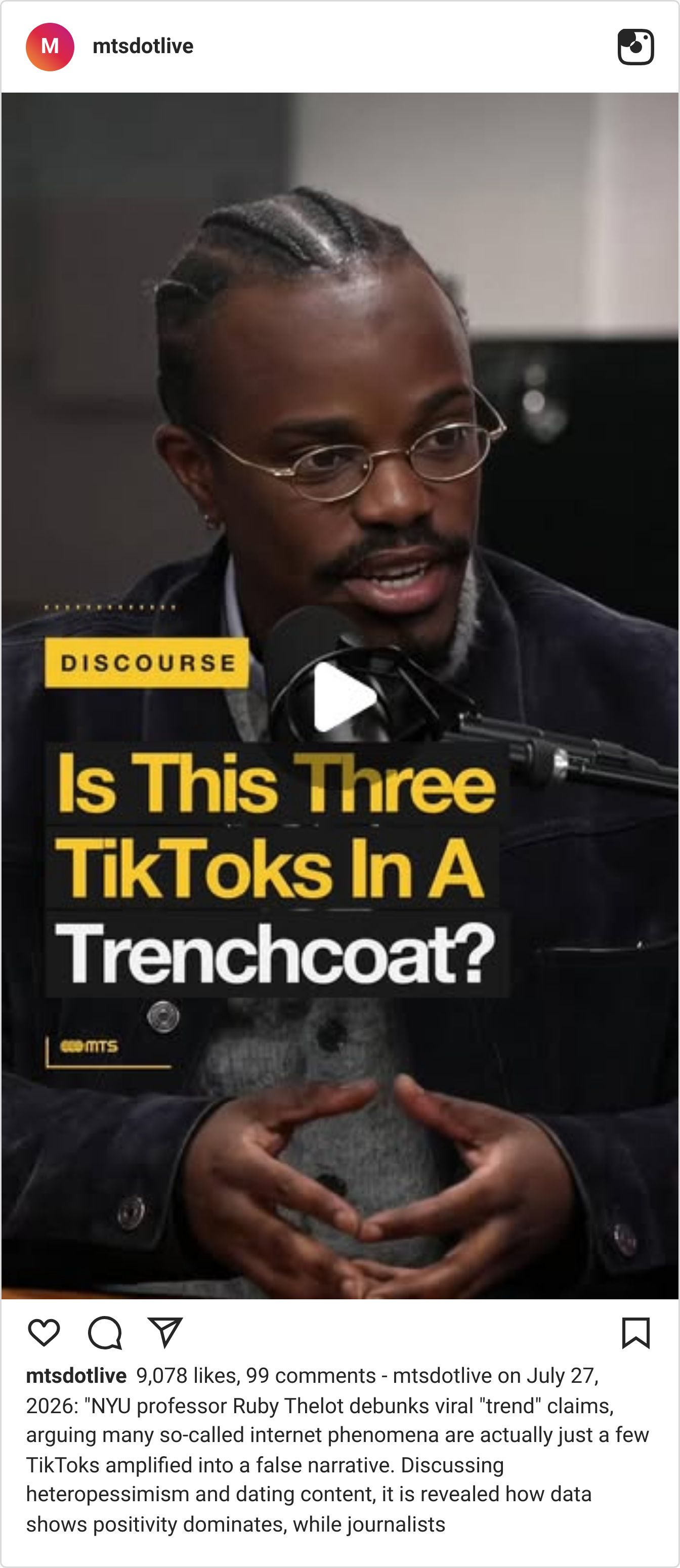
NYU professor and cyber-ethnographer Ruby Thelot on made up phenomena. If both the guy who investigates where things on the platforms come from (Keith Presley, from the Vulture piece) and the ethnographer are saying the SAME thing, isn't that a sign it's time to be more skeptical and share less nonsense?
With this flood of bullsh*t and so many people replicating it thinking about their own personal brand, shouldn't that push us in a less exploratory and more fact-checking direction? Everyone wants to do the fun part, which is coming up with theory and doing exploratory research, but verifying and cleaning data, which is just as fundamental, nobody wants to know about? By the very nature of what our work is, shouldn't we be more investigative journalism and less tabloid press?
Now, how many of these "phenomena" wouldn't disappear immediately if the language and format of social media didn't shape the discourse (but not necessarily what's actually happening) so directly? Aren't the side effects of this ultra-processed information diet already clear enough?
Is it darkest right before dawn?
A year and a half ago, I wrote an article about a possible saturation of the attention economy. Since then, things have moved along quite a bit and the signs are out there:
More countries have banned minors from accessing social media and several others are studying the best way to move in that direction.
One of the most directly implicated companies has a cannon pointed at it worth more than 90% of its market cap, where what's at stake is the addictive potential of the feeds. Their defense argues that this alleged addiction doesn't appear in the DSM, a key medical reference for psychiatric disorders. Curiously, the only non-substance addiction already recognized by the DSM is gambling addiction, which is precisely the "inspiration" for several very visible mechanics on the platforms: infinite scroll and pull-to-refresh (the slot-machine lever), intermittent reinforcement and unpredictable rewards (engagement), and progress counters (notifications, likes, etc.).
Even LinkedIn, once painted as the most AI-slop-infested of all the platforms, made a radical turn: it gave users a tool to report this kind of content. The shame is that, surely because of the commercial incentives, it'll be used spuriously, for example to sledgehammer competitors' reach or even ideologically opposed viewpoints, a bit like how the downvote button works on Reddit. Does it serve as proof that when mass junk content threatens revenue, the platforms react?
This one is subtler: when someone says a thing or a person is "from Shopee," like Caio Castro from Shopee, there's a negative connotation meaning fake, inferior quality or generic (the way calling something "a Temu version" signals cheap or knockoff in the US, for example). Saying someone is something "of Instagram," like a guru or expert, already carries a similar negative connotation. Is this the Faustian bargain of visibility?
If Google's role changes, with AI summaries pulling so many clicks from search results that some companies are already considering "zero Google" strategies, the migration of investment could make social media's saturation even harder to dispute: higher media costs, ever-lower organic reach, more and more paid content, people and institutions using ever more attention-grabbing and frankly cheap tactics for reach and visibility even in sectors and topics where credibility is absolutely central, like high-level journalism, healthcare, scientific and market research. If the "poisoning of the well" rises further, how will audiences behave?
Now, this rock bottom we're at looks a lot like what Cory Doctorow proposed as the final stage in the cycle of ensh*ttification: first the platforms are good for users (chosen content, organic reach, interests prioritized), then they abuse users in favor of B2B customers (cram in more ads and suggested content, open up more user data). The last stage before the end is when value is being sucked out of everyone at the same time (with more expensive ads and a high rate of fraud) and all that's left is a carcass vaguely resembling what the platform once was. Could we argue we're already there?
There are still people arguing that if you speak the platform's language even while talking about serious stuff, you get reach, using the (fantastic) biologist-turned-science-creator Mari Krüger as an example. The thing is you can't treat the exception as the rule. Not coincidentally, in general it's people who want to sell you "posting like a creator" as a course, mentorship, etc. My reading is the opposite: if you're a specialist in a subject (and not a full-time creator), are you really willing to dance dressed up as a virus and spend a lot of money and time on production to be seen by a large number of people, most of whom aren't the natural audience for your work, and to let exactly those people, mediated by an algorithm that optimizes for the things I already mentioned, steer the agenda and direction of what you produce? Isn't that battle already lost by design? Isn't being forced to turn everything into accessible entertainment or outrage a sign of saturation in itself?
For at least ten years, trend bureaus, strategists and researchers have talked about curation as a (vague) way out of these problems, but it never quite materializes, because the problem is that curation that depends to any degree on algorithmic distribution to grow will invariably be contaminated by those same ills. The clearest example of this is maybe Substack, which showed up selling itself as an alternative to a digital information diet based on carousels and short videos, where begging for likes wouldn't be necessary anymore. They swore they'd never have an algorithmic feed until they changed their minds in 2023.

To understand how and why this decision was made, including with testimony from Substack's own leaders, this article breaks it down in detail. The most curious thing is that it arrives, by a completely different path from mine, at the same conclusion: from the moment an algorithmic feed exists on a platform, it's the thing that really controls the format and the language of what gets produced, with the results I argued in this piece.
Isn't it time we started managing the risks of our bets and investing, even gradually, in other ways of being found and recommended?
Thanks for reading all the way to the end (longest edition yet!) and see you in the next one!
